Showing posts with label Nonfiction. Show all posts

Slavery, Underground Railroad, and Freedom

During Civil War Day, our children were enthralled with seeing a hiding place from the underground railroad.  Then, a month later, when we visited the Smithsonian National Museum of American History, one of the first exhibits the children explored was entitled "Slavery at Jefferson's Monticello: Paradox of Liberty."  Again, their interest was sparked.
So, instead of just choosing one book about slavery, the underground railroad, and freedom, I opted to borrow five from our library.  These were used as a preview to our upcoming history lessons.
Two books I read aloud to all our children.  They were...
While reading both books, I cried as we read of families being separated and dangers faced to get to freedom.
Three other books were checked our for our older children to read.  They were...

We'll be studying slavery, underground railroad, and freedom over the next several months as we begin our formal history lessons again soon.

Previewing Our History Lessons


We are still enjoying our summer break, but that doesn't mean we aren't learning new things!

For the most part, our summer learning has been very laid back and relaxing.  However, one thing I definitely wanted to do over these relaxing weeks was provide our children with an introduction to some of our upcoming history topics, especially for the younger children.  The older two children have been through this time period before, but even so, a refresher can be nice before the school year 'officially' starts.

A few library books we borrowed recently...

Whatever Happened to the Pony Express, by Verla Kay
Using a poetical style, Verla Kay intertwines family letters with a wonderful poem full of strong rhythm and fun descriptive words. This style made the book an enjoyable read aloud with fascinating facts interspersed.  {Personally, I learned about the trial run with camels, which didn't work out and were replaced by horses.}  The extended family's communications span the time period of the pony express.  The family's dilemmas increase with time, and are eventually worked out just as the telegraph and trains completely replace the pony express.  It was a wonderful way to trace the historical developments of delivering mail throughout the continental United States.

Civil War Drummer Boy, by Verla Kay
Another selection by Verla Kay was also a poem.  Civil War Drummer Boy is the story of a young boy who becomes a drummer for the Confederate Army.  Though the book has an adventure feel to it, the reality of war is shared.  Vivid words describe the experiences of Johnny as he signs up, serves, and eventually returns home during the Civil War era.  The ending does leave readers with some hope as the family gathers on a porch to enjoy the flower blossoms and one another.  

A Picture Book of Sam Houston, by David A. Adler and Michael S. Adler
This one was quite the informative picture book biography.  We learned about Houston's political career as governor, senator, and president of Texas. Intertwined amongst these roles, we read about Houston's personal beliefs against slavery and his courage to stand up (and lose his job) because he would not be swayed to sign something he didn't believe: a loyalty oath to the Confederacy.  The illustrations by Matt Collins are superb, soft pictures filled with vibrant colors.

The Cowboy ABC, by Chris Demarest
A fun alphabet book telling about cowboys and the west was another read aloud.  Each page has one letter and one short one sentence per page.  The illustrations show the idea or item of the word highlighted for that letter.  Some of those items are kerchief, lariat, reigns, and tumbleweed.  It was a simple and easy introduction to cowboy and western life for my youngest who will begin kindergarten soon.

Looking at Lincoln, by Maira Kalman
This book was about a young girl who sees a man who reminds her of Lincoln.  This prompts her to research and learn more about Abraham Lincoln.  She shares her findings within the book by narrating them to the reader.  Interesting tidbits, like there are 16, 000 books written about him, are blended with common facts about his schooling.  The main character exudes a fascination and admiration of Lincoln which makes the fact reading enjoyable.  Our children recognized the Lincoln statue referenced to at the end, because we had visited it years ago on one of our trips to D.C.

Not only does this simple preview of a few of our history topics excite our children, it helps me to plan for our upcoming year as I gauge their interest and knowledge.

Reviewing the Ocean

This past school year, my youngest two children studied the ocean, water, and coral reefs during our science co-op class.  It was a unit that lasted several months.  At the end of the unit, not only had each child made their own coral reef diorama, but we visited a natural history museum for a special presentation on oceanic food webs.  Then, our family was blessed with a trip to the aquarium when we visited family in New England over the holidays.  It was a wonderful time of learning.


However, sometimes I wonder just how much my children retain.  Of course, I do not expect them to remember every little detail, but what do they remember of the unit?

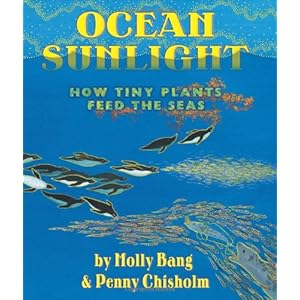
It has been months since we even discussed the ocean unit.  I thought it might come up during a recent trip to the beach, but the children were fascinated with the gulls and a little lizard we found.  It did not bother me.  We were at the beach to relax and have family time.  Any learning and observing was definitely unstructured and unplanned.  However, while visiting the library, I stumbled upon a new book called Ocean Sunlight: How Tiny Plants Feed the Seas, by Molly Band & Penny Chisholm.  It seemed like it might be good as a review for the children.


Ocean Sunlight: How Tiny Plants Feed the Seas


What a find it was!  This book, had it been published and available during our unit, would have been a great resource.  The entire book travels through an oceanic food web starting with the sun rays reaching earth.  The cycle continues all the way through the ocean even down to the twilight zone.  The engaging text draws the reader along the energy paths.  It ends with a message about the importance of the sun in sustaining life in the ocean. 

Overall, the book is fabulous.  It is informative without being dry and dull.  The amount of text on each page makes it an easy book to read, and the illustrations are vibrant and interesting. 

The only minor issue I have with the text is the way the author refers to humans as animals in the beginning of the book.  "Animals - yes, animals like YOU! - eat the plants,..."  This wording I changed to Animals and humans eat the plants.  It is a small distinction, and some might not even find it necessary. 

At the end of the book, a section of notes explains in detail some of the items mentioned in the text.  Our children skipped this section.  It didn't look as fun with all the text (two columns on each page!).  However, for the parent, teacher, or interested child this section offers a lot more information.  It does include a few paragraphs outlining evolutionary thoughts on phytoplankton.  Honestly, this disappointed me.  The book itself is solid in explaining a food web.  Though I wasn't shocked to see it there, it really wasn't necessary to add the evolutionary topics.  Despite my disappointment in this, I would still recommend this title to anyone studying oceanic life or food webs.

Are you designing or planning for your own ocean unit? 


Perhaps a few of these past posts will help:
A Wet Lesson on Water
An Ocean Lesson
Water, Ocean, and Coral Reefs
Coral Reef Dioramas
A Trip to the Aquarium

Light House Books


When our youngest finished his A to Z preschool year, I decided to review his letters and sounds, numbers and counting until summer break.  With that in mind, I started looking through the library shelves for some interesting books with a summer theme or summer topic.  We had already spent a great deal of time in science co-op learning about the ocean and coral reefs, but we hadn't really touched upon light houses.

Last year, for Mother's Day we had hiked to a nearby light house, and I knew our youngest remembered the experience.  He knew what a light house was for and the importance of it.  Without having to explain this to him, he could simply enjoy two new to us books we found at our local library.

The Bravest Woman in America, by Marissa Moss, describes the true adventures of Ida Lewis in picture book form.  Ida grew up with a father who maintained a light house in the mid 1800's on the coast of Rhode Island.  Ida helped her father and eventually became the light house keeper.  The book we read told about Ida's first time saving lives at sea.  Apparently, Ida went on to save many lives and was even awarded the Congressional Life Saving Medal.  Following the story, an Author's Note offers a brief biographical sketch of Ida's life and work.
 
The Sea Chest, by Toni Buzzeo, offered a poetical version of a light keeper legend.  Set on the coast of Maine, this book tells the tale of one light house keeper's family who finds a chest wrapped in bedding.  Upon opening the chest, the family of three finds a baby with a note attached to her wrist.  The family adopts the child and raises her on the light house island.  Though the story is based on a legend and its truth is unknown, the story offers readers a sweet reminder of grace and love with the beautiful message of a child being a blessing.

In the past, our older children have enjoyed other light house books.
From our personal book shelves -
Manning the Light, by Terry Webb
Keep the Lights Burning, Abbie, by Peter Roop and Connie Roop


Linked to Read Aloud Thursday at Hope Is the Word

Revolutionary War Reads

Since using the series of books for history studies worked well, and there are many, many American history books available begging to be read, I decided to assign a few more books to our daughters. 


This time the history books covered the Revolutionary War time period.  Our youngest read You Wouldn't Want to Be at the Boston Tea Party! by Peter Cook, and our oldest daughter read Can't You Make Them Behave, King George? by Jean Fritz.  Both books are part of different series which place a humorous tone on history, and both books {actually, both series} are just fun to read.  The girls eagerly completed the task of reading and orally narrating their individual books to our family. 

Then, I assigned a bit more reading. 

This time, our youngest daughter compared two books: Phoebe the Spy, by Judith Berry Griffin and Buttons for General Washington, by Peter and Connie Roop.  She liked that the main characters were both children contributing to the war effort by serving General George Washington. 

Meanwhile, our older daughter delved into a Magic Tree House book entitled Revolutionary War on Wednesday, by Mary Pope Osborne.  She also used the accompanying research guide called American Revolution, by Mary Pope Osborne and Natalie Pope Boyce.  This combination of fiction and nonfiction books offered her a fun way to learn more about the Revolutionary War.  After her readings and research, she presented an oral report on the Hessian soldiers.

A side note:  Though our oldest son did read a few books on the Revolutionary War, he is currently working on a project about Benjamin Franklin which I hope to share at another time.

Ships, Navigation, and Whaling

This year, our oldest son completed a small unit study on ships, navigation, and whaling.  This unit fit easily into the context of our current colonial America studies, but reached beyond the 1700's into the 1800's. 


For bite sized nonfiction information, he read Ships, by Philip Wilkinson and Whale Port, by Mark Foster. 

Ships, published by Kingfisher, is divided into four main sections: Trade and Discovery, Ships of War, Peopling the World, and Discovering Ships.  Each section has numerous topics displayed in the typical two page spread of this type of book.  The information was just enough to create an interest and determine a course of more in depth study. 

Whale Port is a fun book that follows the fictional town of Tuckanucket from colonial times to contemporary times.  Though the book has elements of imagination, it is seeped with true facts of interest.  The overall effect was the story of whaling through the years.  It was a good book for my son to read after his recent reading of Moby Dick{He read this title on his own by his own choice.  Though it was not part of this unit study, it did lend itself well to the theme.}

For a personal example of navigation and shipping, he read Carry On, Mr. Bowditch, by Jean Lee Latham.  This biography follows the remarkable life of Nathaniel Bowditch.  Bowditch's determination, perseverance, and diligence are character traits are showcased in this well written book.  If you only want to read one book on navigation, let this be the one.  I highly recommend it.

For more hands on activities and further navigational information, he used Tools of Navigation, by Rachel Dickinson.  This book includes the history, as well as the science, of navigation.  Some of the topics include ancient navigators, explorers, using the stars to navigate, and land exploration. With directions to make your own compass and explanations on contour mapping, the fifteen different activities are applicable and interesting for children and adults. 

Previously read books relating to ships, navigation, and whaling:
All Set Sail, by Armstrong Sperry
Clipper Ship, by Thomas P. Lewis

Martin Luther King Jr. Day and More

A Voice of Her Own: The Story of Phillis Wheatley, Slave Poet

This year, our history studies will only carry us through 1850.  Which is about a hundred years too early for studying Martin Luther King Jr. and the Civil Rights Movement.  However, that will not stop us from incorporating a few history books into our lessons for the day.  Several of the books we will peruse today are...


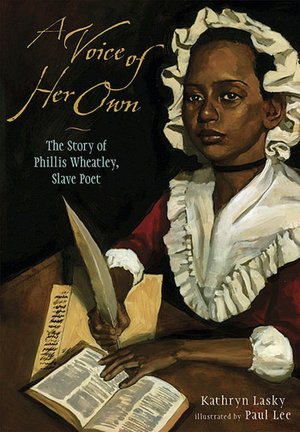
A Voice of Her Own: The Story of Phillis Wheatley, Slave Poet, written by Kathryn Lasky tells of Phillis Wheatley, who lived during the time period of our current history studies.  This picture book biography will be a fabulous starting point. 


Heart and Soul: The Story of America and African Americans, by Kadir Nelson, offers a comprehensive history from the American Revolution through Martin Luther King, Jr.  We will read parts of this together.  Then, I will ask the older two children to take a few days and read through it independently.


and


My Uncle Martin's Words for America, by Angela Farris Watkins, PhD., rounds out our mini unit.  A fantastic biography using Martin Luther King, Jr.'s own words intertwined into the narrative.  The repetition of key words like love and freedom focus the reader on the values King promoted.  It is an excellent introduction to the impact of his life.


Another book I should mention is one that we read almost every year.  It is The Story of Ruby Bridges, by Robert Coles.  Ruby Bridges is a young girl caught up in the large scale drama of desegregation in the public school system.  Her poise, compassion, and honest outlook are touching and humbling.  {I read this book with a pack of tissues nearby.}

Books for Boys

Lineup for Yesterday

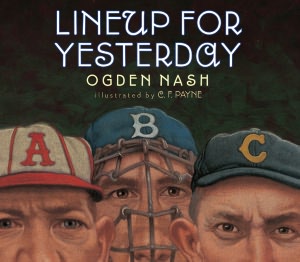
Strolling through the children's section of our library, this cover caught my eye.  Though it is about baseball, I was drawn to the illustrations by C.F. Payne.  The pictures are realistic, but with a bit of whimsy and slight exaggerations of features.  Instantly, I knew my sons would like this book.   

The picture book, like the poem it is based upon, is arranged alphabetically naming twenty-four iconic baseball players.  Two letters, I and Z, do not represent baseball players.  Instead, I stands for the Incurable fan (poet Frederick Ogden Nash) and "Z is for Zenith..." 

Lineup for Yesterday, by Ogden Nash features not only the poem, but biographical inserts for each of the players mentioned.  The informative biographical notes were written by Nash's daughter, Linell Nash Smith.  The book can be read in a couple of ways.  For younger listeners the main alphabetical poem is sufficient, but for older audiences, the poem and biographical information can be poured over together.

-

Another book we read offered more comedy than history.  Entitled Levi Strauss Gets a Bright Idea, the book's subtitle, A Fairly Fabricated Story of a Pair of Pants, hints at the tone to come.  Written in the style of a tall tale, Tony Johnston tells the story of Levi Strauss and the invention of denim jeans. 

The book had us laughing with delight as Strauss joins the California Gold Rush, only to discover he is late, there is no gold left, and the men's pants have disintegrated.  Strauss laments his loss of gold and devises a way to fix the miners' pants problem.  Like any good tall tale, these story elements stretch the historical facts and create a humorous adventure. 

The book does conclude with a page telling the real story of Levi Strauss and denim jeans.

-

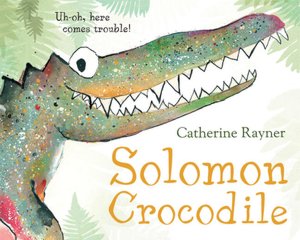
The final book I'll share today was read more for my youngest son.  Solomon Crocodile, written by Catherine Rayner, is a fantastic read aloud book for preschoolers.  The vocabulary used is perfect for my active boy!  Verbs such as stalk, splats, slops, charges, and croaks are his kind of words.  The repetition of several lines makes for a delightful read aloud.

Solomon Crocodile


Linked to Read-Aloud Thursday at Hope Is the Word where you will find a lot more great books!

When the Weather Outside is Cold

Survival at 40 Below

When the January wind starts to blow, and we are driven inside from the cold, it is a great time to learn how animals and people survive and thrive in the colder areas of the globe.  Three books our children have read (or were read aloud) are:

Survival at 40 Below, by Debbie S. Miller, describes life just north of the Arctic Circle in Alaska's Gates of the Arctic National Park and Preserve.  The book begins in autumn.  Animals are scurrying to prepare for the next eight months of winter.  Miller explains how a wide variety of animals get ready for snow and survive cold winter temperatures.  We were fascinated by the frog freezing and the squirrel's cyclic hibernation.  Another interesting tidbit we learned was about a caterpillar that spends 14 winters in the caterpillar phase and after those years, just one summer as a moth.  The book concludes with an author's note explaining her inspiration behind the book and a glossary defining possible unfamiliar terms.

Another book set in an Arctic winter is Welcome to the Ice House, by Jane Yolen.  A plethora of animals from land to sea who find homes in the frigid Arctic winter are presented.  Lovely illustrations by Laura Regan set a tranquil tone and the lyrical text creates a melodious read aloud.  A final page entitled "Did You Know?" explains the origin of the term 'arctic' and offers the University of Alaska Museum website address for more information.

For a different perspective on the cold, the book Antler, Bear, Canoe: A Northwoods Alphabet Year, by Betsy Bowen depicts life in the northwoods of Minnesota.  While moving through the alphabet, Bowen shares a bit about the northwoods from January to December.  Each entry portrays an activity, observation, or incident from the author's life.  This provides readers with a more personal connection with life in the northwoods.  The wood block illustrations lend to the rustic appeal of the book.


Over the years, we have enjoyed a great variety of books set in the Arctic or winter time.  Below, I have listed a few all time favorites.

Other books set in the Arctic or cold, winter time:
In the Far North, by Lola Kamalova
Arctic Son, by Jean Craighead George
The Long Winter, by Laura Ingalls Wilder
Adventures of an Arctic Missionary series, by Gloria Repp
Trapped by the Mountain Storm, by Aileen Fisher
Snowflake Bentley, by Jacqueline Briggs Martin
Tikta'Liktak: An Inuit-Eskimo Legend, retold by James Houston

Animals on the Move and at Rest

Animals fascinate our children.  Their diversity in appearance, movement, rest patterns, and homes captivate our young ones' interest.  When I found a few more books at our local library on animal travels, migrations, and resting, I plucked them right off the shelves.

Race the Wild Wind: A Story of the Sable Island Horses

Though we are quite familiar with the wild horses of Chincoteague and Assateague Islands, we had no idea there was a similar island located off the shores of Nova Scotia.  The origin of the Sable Island wild horses is a mystery.  In her book, Race the Wild Wind, Sandra Markle explores one theory of abandonment using a race horse, work horses, and various other types of domesticated horses.  The story line centers on the race horse stallion and his acquiring a herd of mares.  Spanning about two years, the book explores how the horses might have survived those very first seasons on the island.  The book includes an author's note discussing the possible reasons the wild horses live on Sable Island, other books and websites for more information, and a short list of interesting horse facts.


Our youngest son adores turtles.  Finding a book on turtle travels for him was a highlight to this mini unit.  Turtle, Turtle, Watch Out! by April Pulley Sayre outlines a twenty year time period of turtle travel.  From Florida shores to a coral reef and back, the turtle travels and thrives despite predators.  A repeating line like the title adds to the excitement of the dangers and escapes.  Overall, the book is fun and appealing.  With its short text and colorful pictures, Turtle, Turtle, Watch Out! is an easy read aloud for younger children.

Covering ten traveling animals, Going Home: The Mystery of Animal Migration, by Marianne Berkes, delves into seasonal migrations.  Each two spread page displays one specific animal, including caribou, arctic terns, and pacific salmon.  For each animal, a short descriptive paragraph appears on the page within the book and another informative paragraph is located in the back of the book.  Overall, the lyrical text can be read two stanzas per page without reading the descriptive paragraphs.  I liked reading it this way the first time through the book.  It lent itself to a more cohesive read, and the rhythm of the words was easier to hear.  There is a sense of movement and underlying urgency in the rhythm that mimics migration.  However, the descriptive paragraphs are worth a read through afterward.  Berkes has spent many years working with children, and this is evident in the "Tips from the Author" section in the back of the book.  Many creative and extension ideas are included.

For our older children, a more textual book, The Journey: Stories of Migration, by Cynthia Rylant was read.  Highlighting a half dozen migrating species, Rylant takes the reader on a journey world wide.  Locusts, grey whales, and butterflies are a few animals highlighted.  Each animal is covered in about six pages and includes idyllic illustrations.  From the text, readers sense wonderment of how incredible migration is.  Some fascinating tid bits we learned included a herd of caribou nearly 200 miles long and female eels traveling from salty ocean water to fresh water streams to live for ten years before returning to the salty ocean water.

After all that travel, animals need to rest!  And, so we capped off the mini unit with a short book entitled Animals Asleep, by Sneed B. Collard III.  This is another book that can be read through twice.  By reading the sparse large printed words from each page and enjoying the animal pictures, the text whets the appetite to know how and where all these different animals find rest.  The second time through, the descriptive paragraphs for each animal explain the how and where.  Collard certainly included a vast array of animals and sleeping habits.  Tid bits like sea otters sleeping in a bed of kelp offer a fun outlook on rest.  There were a couple of word choices that pointed to evolution, but nothing explicit. {I simply omitted or changed these words to reflect our family's beliefs.}


Christmas Past - Historical Read Alouds

There is a plethora of Christmas books at our local library. So many that we could probably read them all year long. However, we generally try to wait until after Thanksgiving. Some of our favorite library finds this year follow.

Historical Selections:

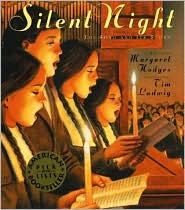
Silent Night: The Song and Its Story, written by Margaret Hodges, shares the story behind the well know Christmas song "Silent Night."  Beginning with its origin in a small Austrian village and following the song's world wide impact through the years, this picture book is interesting for grown ups and children alike.


When Washington Crossed the Delaware, written by Lynne Cheney, tells of the cold winter of 1776 and the Christmas crossing of American troops led by George Washington.  After a spring trip to Valley Forge, the children had a keen interest in this book.  In fact, this year, the children and their cousins will be performing an original play called "A Valley Forge Christmas" at our family's annual Christmas gathering .

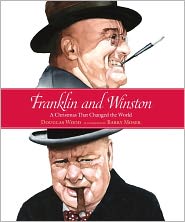
Franklin and Winston: A Christmas that Changed the World, written by Douglas Wood, was a fascinating read for me and the children.  Telling of the Christmas time visit between Prime Minister Winston Churchill and President Franklin Delano Roosevelt, Wood intermixes light hearted moments and serious somber realities of World War II.

O Christmas Tree: Its History and Holiday Traditions, written by Jacqueline Farmer, traces the history of using evergreens in Christmas decorations from Ancient Egypt's usage of palm branches through Middle Age European pine tree decorations to present day American Christmas tree farmers.  The book is filled with tidbits of information, such as the first time electric lights were added to the White House Christmas tree and Massachusetts' almost two hundred year ban on Christmas.


Linked to Read-Aloud Thursday at Hope Is the Word

Christmas Around the World Resources

Hoping to teach our children about how Christmas is celebrated elsewhere in the world, I searched for resources.  A few of the favorite books we found are...

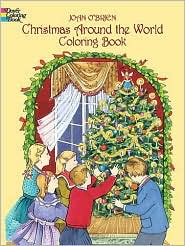
Christmas Around the World Coloring Book, by Joan O'Brien, is a book full of coloring pages highlighting Christmas celebrations world wide.  It also offers short descriptions of each country's unique traditions on every page.


Christmas Around the World, written by Emily Kelley is a small picture book my oldest son and I found on a recent library trip.  Kelley explores Christmas traditions of eight different countries.  Some of the countries are Mexico, China, and Iran.  The customs highlighted within the book are fascinating to read.  We learned about the traditions of Christians in Iraq and the Festival of Light in Sweden.


Another picture book we found on that same library visit was The Christmas Drum, by Maureen Brett Hooper.  Peter, a young boy living in a small village in Romania, anticipates playing the duba (a drum) for the caroling on Christmas Eve.  Peter's father is working in the city and unable to play with the group.  Peter takes his place.  For the entire evening, Peter plays the drum well, and even sings a carol all by himself.

For a more local selection, we read An Amish Christmas, by Richard Ammon.   The book begins with a group of Amish children preparing and performing a Christmas program at their one room school house on Christmas Eve day.  Christmas day is celebrated with family, food, and fun.  The following day, The Second Day of Christmas is celebrated.

Perhaps, if we have time, we will finally travel to the National Christmas Center for a tour highlighting world wide Christmas traditions of past and present.

Water, Ocean, and Coral Reefs

Over the past dozen or so weeks, I have taught ocean life in our Wednesday science co-op class.  I was blessed to use another teacher's lesson plans for the majority of classes, and only had to write lesson plans for three classes. {a class on water, another on oceans in general, and one on oceanic food webs}  However, I was not able to find all the reference books and read aloud books she had used. Each week, I trekked to our local library in search of suitable books to read aloud. Thankfully our library had a large selection of books on most of the topics we covered in class.

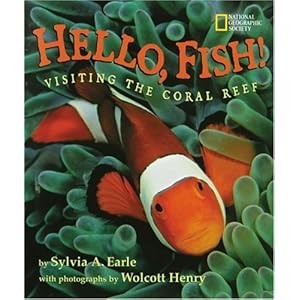
Hello, Fish!: Visiting The Coral Reef


Some of the children's favorite read alouds were...
This is the Ocean, by Kersten Hamilton
The Magic School Bus on the Ocean Floor, by Joanna Cole
The Magic School Bus Takes a Dive, by Joanna Cole
What Lives in a Colorful Coral Reef? by Rachel Lynette
About Crustaceans, by Cathryn Sill
Crab, by Lloyd G. Douglas
Hello Fish! Visiting the Coral Reef, by Sylvia A. Earle
Mister Seahorse, by Eric Carle
Whale Shark: The World's Biggest Fish, by Meish Goldish
Wish for a Fish: All About Sea Creatures, by Bonnie Worth


Related:
An Ocean Lesson
A Wet Lesson on Water
Coral Reef Dioramas

Pilgrims, Native Americans, and Thanksgiving Day

Perhaps it was the field trip to Plimoth Plantation or seeing the Mayflower replica.  Maybe it was just the plethora of information to peruse, or the fact that we lived in Massachusetts for a few years.


Regardless of the reason why, we have a fun time studying the Pilgrims, Native Americans, and Thanksgiving during the month of November. 


Some years, like this year, we are studying that exact time period in history.  During those years, no special unit is completed.  We simply study through the material during our lessons. 


However, on the years when we are studying other historical time periods, we usually take some time, and work through a unit study on Pilgrims, Native Americans, and Thanksgiving Day. 

Some of our favorite books are:
Thanksgiving: A Harvest Celebration, by Julie Stiegemeyer
The Thanksgiving Story, by Alice Dalgliesh
Squanto and the Miracle of Thanksgiving, by Eric Metaxas
Squanto: Friend of the Pilgrims, by Clyde Robert Bulla
The Pilgrims at Plymouth, by Lucille Recht Penner
On the Mayflower: Voyage of the Ship's Apprentice and a Passenger Girl, by Kate Waters
Sarah Morton's Day: A Day in the Life of a Pilgrim Girl, by Kate Waters
Samuel Eaton's Day: A Day in the Life of a Pilgrim Boy, by Kate Waters
Tapenum's Day: A Wampanoag Indian Boy in Pilgrim Times, by Kate Waters
The Adventurous Life of Miles Standish, by Cheryl Harness
N.C. Wyeth's Pilgrims, text by Robert San Souci

A few new to us books that we found at the library this past visit are:
The Story of Thanksgiving, by Robert Merrill Bartlett
Thanksgiving Is..., by Gail Gibbons
The Pilgrims' Thanksgiving from A to Z, by Laura Crawford
The Wampanoag, by Kevin Cunningham and Peter Benoit
1621: A New Look at Thanksgiving, by Catherine O'Neill Grace and Margaret M. Bruchac

Bach and Handel Biographies

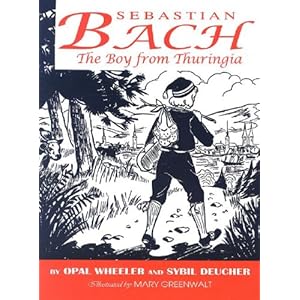
Sebastian Bach, The Boy from Thuringia


Over the past several weeks we have read aloud from Sebastian Bach: The Boy from Thuringia.  Covering a chapter or two a week, we followed Bach's travels and growing musical talent.  Opal Wheeler and Sybil Deucher create an interesting tale of Bach's life with a focus on his music.


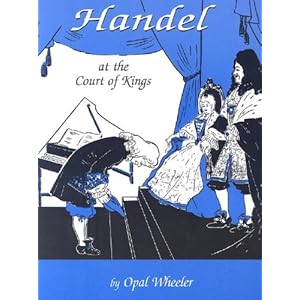
Handel at the Court of Kings


Following the biography of Bach, we decided to read of Handel.  Personally, I am enjoying this one far more than Bach's biography.  Perhaps it is due to Handel's passion for music or his father's reluctance to allow him to pursue music as a career, but knowing what a great musician Handel became.


Both biographies have study guides and enhanced CDs available.  Study guides have comprehension questions for each chapter and a time line.  The CDs have musical examples of each composer's compositions along with coloring pages and sheet music that can be accessed and printed.  We used the CD to its fullest extent.  I print up the pages for the children and play the music when called for in the readings.

Although we have the study guides, we haven't been using them.  Instead, I use a few coloring pages for each chapter.  As I read the chapter or chapters aloud, the children color a picture of their choice.  After the reading we discuss what we've read and I write some of the names of people and places on the chalk board.  Then, each of the older children writes a summary of the chapter they just heard.  We file these pages into their history notebooks.


To find out about more read aloud selections, visit Amy at Hope Is the Word
for this week's Read-Aloud Thursday link up.

Nature Walks and Activities

Being outside, enjoying God's creation is one thing everyone in our family enjoys.  Whether playing, walking, or exploring, being outside is refreshing and relaxing to us.  Sometimes, we do more than enjoy.  We observe or study bits and pieces of the surrounding nature. 

My favorite way to help the children become more observant of their natural surroundings is through nature walks.  I am pretty confidant this idea stems from Charlotte Mason who advocated getting children outside at least once a day in all sorts of weather.  We are a bit more lax.  Instead, we opt to traverse about on nice, pleasant days.  Sometimes, we bring notebooks, pencils, colored pencils, and identification books.  On these walks, we'll pause in an area and try to draw a plant, animal, rock, cloud, or something else of interest.  After we have spent time observing the details, we search through the appropriate identification book and read the information outlined in the book about our chosen subject.  Then, the child will write, or dictate as I write, a few sentences about the item.  More recently, we have started bringing the cameras along.  This allows the children to photograph bugs, leaves, or trees of interest.

For more hands on learning ideas about nature, we like
The Kid's Nature Book, by Susan Milord
Fun with Nature: Take Along Guide, by Mel Boring, Diane Burns, and Leslie Dendy
More Fun with Nature: Take Along Guide, by Laura, Evert, Mel Boring, Diane Burns, Christiane Tibbitts, Linda Garrow, and John McGee

From the Library Shelves

I am pretty sure this blog should come with a warning or some type of confession like,
"Hi, my name is Dorie, and I really love books.  Short ones, tall ones, thick ones, thin ones, they all have something beautiful to offer.  Opening a new or old book is a moment of joy.  Finding well chosen words and lovely illustrations within the pages only deepens this joy..."

With such a passion for written words, I hope to foster a love for reading in each of our children as well.  Our home reflects that desire with many books and places to curl up and read.  Helping to feed this passion are our frequent visits to the local library.  Each time, we come home with arm loads of books, and a few new favorites.  This last trip was no exception.

Straight from the shelves of our local public library to our home...

A Good Knight's Rest

Each time we visit the library, the children peruse the shelves for interesting books.  When my four year old spotted a book about a knight and a few dragons, he immediately asked to bring it home.  From the first reading, the storyline has delighted him.  A Good Knight's Rest, by Shelley Moore Thomas tells of a knight who needs a vacation.  He attempts to take one with three little dragons in toe.  The antics of the dragons make my son laugh each and every time we read through this book.  {And we've read it almost everyday now.}  Definitely a good find!


What Lives in Coral Reefs? (Animal Habitats)

For our science co-op, the PK-third grade class are learning about oceans.  I couldn't find the book recommended in our lesson plans and had to rely on a quick library search for a substitution.  Since explaining coral reefs can be hard when the students have never seen one, I definitely needed to find a book with lots of pictures.  What Lives in Coral Reefs? by Oona Gaarder-Juntti does a fabulous job of explaining and showing what coral reefs are and what animals live there.  The book includes vibrant, up close photographs of beautiful coral and ocean life.  Each page has minimal, but interesting information.  The book made for an excellent read aloud to a group of wiggly early elementary students.

An Ocean Lesson

For the second science co-op class I wanted to cover oceans in general.  The materials and lesson plans that I had borrowed specifically used coral reefs for studying ocean life.  While I am excited to present these lessons to the students, I still needed one more lesson to fill in our scheduled time.  After investigating water, the next logical step was to discuss oceans in general.  This would easily progress the class to the coral reef study the following week.

Melissa & Doug Under The Sea 100 - Piece Floor PuzzleThe Magic School Bus on the Ocean FloorWe began similarly to the first class, but this time listed "What We Know About Oceans."  Finding all the oceans on a world map, each child colored and labeled their own personal size map.  Next we read The Magic School Bus on the Ocean Floor, by Joanna Cole.  The children love these science stories filled with fascinating facts.  We discussed some of the information, and then tried to put together a huge 100 piece floor puzzle called Under the Sea, by Melissa & Doug.  The children pointed out different animals, and then we played "I Spy" using the floor puzzle.  This puzzle is a beautiful illustration of a cross section of the ocean.  Springing from the puzzle to the levels of the ocean was easy.  We talked about the various zones of the ocean and how much, or how little, sunlight each received. 

Awesome Ocean Science (Kids Can! series)This discussion led to several demonstrations of how scientists have determined the depths of the ocean floor.  Using a library find, Awesome Ocean Science, by Cindy A. Littlefield, the children made sounding lines connected to a small floating 'boat,' watched water stream out of a bottle due to pressure, and felt water pressure by inserting their hands into large buckets while wearing a bread bag glove.  The favorite activity of the day was a different water pressure demonstration from the same resource.  Littlefield suggests filling a tall glass with water and attempting to blow a single bubble at various depths.  The children squealed with delight over this activity.

Class ended by summarizing "What We Learned About Oceans," and a snack.  Beginning this week, I'll be using the lesson plans I borrowed from the previous teacher.  Though it was fun to pull together two extra lessons, I am very grateful to not have to create a lesson every week for the rest of the school year.  For the remainder of the ocean unit, we will study coral reefs in depth.  Each student will be making their own coral reef model.  I won't be sharing her lesson plans, but will share any extra ideas that I add to the unit.

Related:
A Wet Lesson on Water

A Wet Lesson on Water

This is our second year participating in a local science class co-op.  Last year, I helped with the fourth and fifth graders, but this year, I am teaching the PK to third graders. 

Our units of study will cover ocean life and chemistry.  The mom who taught this class for many years before me has graciously lent me her lesson plans.  For this, I am incredibly grateful, especially because I feel a little intimidated 'taking her place' as lead teacher.  The lesson plans are wonderfully laid out and will be easy to follow.  However, the year she taught these units, science co-op had two less classes scheduled.  Figuring it would be easier to expand the ocean unit, I pulled together two lessons to add at the beginning of the school year. 

The first class was an introduction to water.  Since all of the children were familiar with water in general, we began the class by creating a list of "What We Know About Water."  After listing many serious and silly facts about water, we moved onto some water explorations.  These investigations were from Water, published by Evan-Moor Corp as part of the Science Works For Kids Series.  Students learned about water taking the shape of its container, traveling to the lowest spots, and having surface tension.  The pennies in the bowl demonstration was their favorite.

WaterNext, we learned about the forms of water, including solid, liquid, and gas.  The children labeled a worksheet.  Using red arrows to represent heating and blue arrows to represent cooling, students decided how water went from one form to another.  Then, using another idea from Water, I asked the children to pretend they were water droplets.  Each student stood very still and very close to one another when they were ice (solid form).  For water (liquid form) the students moved slightly apart and moved slightly.  Spreading far apart and dancing, the students pretended to be steam (gas form).  We then played a game.  As the children continued to pretend to be water droplets, I held up a blue piece of paper.  The blue represented cooling, and the children had to decide if they were to move closer and become still, or move further apart and dance.  When I held up a red piece of paper they again needed to decide how to move.  We played for several minutes moving through the three forms. 

This is the OceanThis activity easily led into an explanation of the water cycle.  By reading This is the Ocean, by Kersten Hamilton, the children learned about water droplets traveling from the ocean to the air, over land, and down to rivers that travel back to the ocean.

A Project Guide to Earth's Waters (Earth Science Projects for Kids)We followed the reading with a water cycle demonstration I found in A Project Guide to Earth's Waters, by Christine Peterson.  Having tried the experiment a few days before class, I knew it would work.  The children could see water, a bit of fog, and condensation.

Once the water cycle demonstration was completed, I wanted the children to observe what happened when fresh river water flowed into salty ocean water.  In another book from the library, I found the perfect demonstration.  Awesome Science! Investigating the Secrets of the Underwater World, by Cindy A. Littlefield devised a easy to implement investigation.  Tweaking the instructions a smidge, I made the salt water very salty to ensure success.  Also, I had to use spring water and not tap, as Littlefield suggests.  Our tap water did not work, as it is treated with too many chemicals.  Once those alterations were in place, it was fascinating to watch the fresh water float on top of the salt water. 

Awesome Ocean Science!: Investigating the Secrets of the Underwater World (Williamson Kids Can Books)A small discussion on waves mixing fresh and salt water followed, and the class concluded with a summary activity of listing "What We Learned About Water." 


I had hoped to end the class with a few outside water games as it was a hot day.  Unfortunately, we ran out of time.  Tomorrow, I'll share the second lesson.
Related Posts Plugin for WordPress, Blogger...