Showing posts with label Logic. Show all posts

Detective Themed Party Games


The birthday girl chose the detective theme, but asked me to do the games, which meant a little bit of pressure for me.  Honestly, I wasn't sure if I should make one big mystery with evidence or do multiple games with a detective theme.  In the end, I chose multiple games because the children coming to the party ranged in age from two to thirteen.

Initially, the children began in the back room (our school room).  The children's tables were set up as game stations which the children could complete independently.  Before they began, I gave each child a folder containing a few word games, such as a word search and a word unscramble, to do if needed while waiting for a game. 


The games stations are described below.  The games were targeted for elementary and middle school students.  For most games, I had devised a "Younger Detective" activity as an alternative for the preschoolers.

Scented Balloons
Using an activity from a past science co-op class, I scented different colored balloons.  Children had to use their keen sense of smell to decide what each scent was.  Younger detectives had colored strips of paper to match to the balloons.


Word Find
Taking a few printed pictures on regular paper, I wrote words within the pictures.  I tried to write very small so the children would need to use the magnifying glasses to see each word.  The children recorded their findings on paper.  Younger detectives named shadow shapes.


{to make "Shadow Shapes" for Younger Detectives}
 
trace shapes on black paper with white pencil
 
cut out shapes and paste onto contrasting color cards
 
In the Bag
Eight different brown bags held regular household objects.  Children were instructed to identify what the object was by using only their sense of touch.  No clues were given as to the contents.  Younger detectives continued their shadow game by trying to find objects within the room to match the turkey shadow shape card.


Thumb Print Art
At this game station, children were encouraged to use their imagination to make pictures out of their thumb prints.  We had found a book by Ed Emberley (Thank you Jessica for mentioning him!) which gave us lots of ideas for thumb print art.


After completing all the games, the children were given a puzzle to assemble.  The puzzle pictured where their prizes were located. 


Only once they found the prize location, it was empty.  A letter started a series of riddles and clues which moved the children inside and outside the house in search of their next clue and eventually the prizes.  Then, when the prizes were found, the children had to determine who had hidden their prizes.  Using several clues the children eliminated potential culprits (attendees to the party).  After a few guesses they finally pronounced Nana as the guilty person.  {She had volunteered to be guilty prior to the party.}


All in all, the children had fun and the games seemed to work well for such a large age span (2-13 years old).  More importantly, my daughter, the birthday girl, liked it!

Curriculum Reviews - Math and Logic

Yesterday, I shared our Language Arts curriculum choices.  Another vital area of study is math.  No matter what they study, we believe our children need to learn to read, write, and work with numbers. {the three R's}


Math ~
For math, we begin early with hands on learning, counting, and sorting.  Often we pull out the manipulatives and allow the children to play with the counters, shapes, and various items.  Starting in the year before kindergarten, we use Saxon Math K.  It introduces math concepts slowly.  We use the entire curriculum with the meeting book and manipulatives.  I tend to only use the extra writing sheets if necessary.  I'd rather not over tax a preschooler with repetitively writing numbers.

Once the child begins kindergarten {aka 'official school'} we use another year of Saxon.  This time it is level 1.  The child progresses at their own pace.  Although we use the entire curriculum with the meeting book, workbooks, and lesson scripts, we will alter when necessary.  Saxon Math tends to offer a great deal of review, and for the child who thoroughly understands a concept the review can become tedious.  The worksheets tend to be the exact same problems on both sides.  One side is to be completed during the morning and the reverse is to be completed later in the day.  While this is a beneficial review, it can be a bit too much, and sometimes, we opt to just complete one side per day.  Some of our children have progressed through Saxon Math up to and including level three by the end of second grade.  Some of our children have only used Saxon for preschool and kindergarten.

Typically, we have either moved into Horizons Math in first grade or third grade.  If the child begins Horizons Math in first grade, they start with the first grade level books.  If the child transitions from Saxon Math, in the third grade, despite being one level ahead in Saxon, I will place them in the grade appropriate level for Horizons Math.  Horizons Math tends to introduce concepts a bit ahead of a typical school schedule.  The cyclic, or spiral, approach to learning still offers plenty of repetition, but builds the child's mathematical knowledge in a slightly different manner.  Horizons also tends to move through concepts a bit faster than Saxon Math.  We then use Horizons Math through the Pre-Algebra level.


Logic ~
Though we have yet to do formal logic lessons, we have begun to lay the ground work for critical thinking and logic.  

Some of our favorite resources for critical thinking come from The Critical Thinking Co.  Our children thoroughly enjoy both the Mind Benders and Red Herring Mysteries.  The children work through the Mind Benders series on their own.  We prefer to work through the Red Herring Mysteries as a group.  It is fun to discuss each problem or mystery and determine different solutions. 

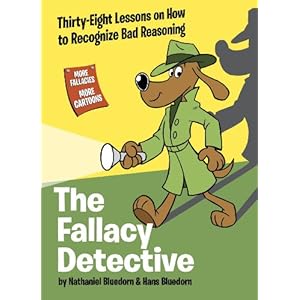
During the middle grades, we begin to delve a bit more into logic using The Fallacy Detective and The Thinking Toolbox.  Both books are written by Nathaniel Bluedorn and Hans Bluedorn.  So far, we have only used these books with our oldest son.  Each book has a conversational tone.  The relaxed approach to learning a few logical terms and ways to organize arguments has made learning a bit about logic easy and enjoyable.


Related Posts:
Early Learning: Math Manipulatives
Learning Math Concepts
Math Resources for the Middle Grades
Learning Logic

Learning Logic

Who knew the wealth of information I would learn as I began teaching our oldest logic?  Using The Fallacy Detective, by Nathaniel Bluedorn and Hans Bluedorn, we began our logic studies informally.  Each week, we read and discuss a lesson.  The brief lessons are designed to be completed alone, in pairs, or in a group.  Topics include making assumptions, statistical fallacies, and propaganda.  The lessons flow easily from one fallacy to another with built in review. 

Our oldest son is enjoying his first lessons in logic, and I have been gleaning great nuggets of knowledge as I guide him through this book.

The Fallacy Detective: Thirty-Eight Lessons on How to Recognize Bad Reasoning

There have been times, during informal discussions, that I have known a statement or conclusion was wrong, but I did not know how or why it was logically incorrect.  After completing twenty-eight lessons, I now know some of the errors and the types of fallacies.  This small book has only scratched the surface of studying logic, but it has been a fabulous start.  After we complete the remaining ten lessons, my son and I plan to read through The Thinking Toolbox, by Nathaniel Bluedorn and Hans Bluedorn. 
Related Posts Plugin for WordPress, Blogger...