Showing posts with label Planning. Show all posts

Change Your Homeschool


It's the end of the school year. Are you celebrating?

Or, maybe, just maybe...you feel a bit different...

Do you feel like you have run a marathon? Are you exhausted? Have the tears flowed easily?

Have you had a less than stellar year?

Maybe you have made one too many mistakes and feel like giving up?


I understand.
Completely.


We just finished a year which I may or may not have compared our final months to crossing a finish line in a race car with four blown out tires.

Despite this dramatic {or traumatic} ending, I can whole heartedly say:
Don't give up on homeschooling!

Instead, learn from your school year. And for the future...
Change it. Simplify it. Make it different.

15 ideas to Change your Homeschool for the better
or to ponder as you relax in the shade this summer...
  1. Consider teaching less subjects by combining some
  2. Do less - more isn't always better and perhaps some activities could be removed
  3. Try multi-age teaching - (Subjects like history, science, art, music could be taught this way.)
  4. Start counting life learning lessons towards school time
  5. Try year round schooling - more time and less stress to fit it all in
  6. Create a shorter daily schedule
  7. Establish must dos and would be nice
  8. Don't do everything next year
  9. Pursue PE as a family - hiking, biking, boating, swimming, etc. can all be done as a family
  10. Change the physical surroundings - switch homeschool rooms, rearrange the furniture, change the wall décor to a more welcoming appearance 
  11. Organize the books and supplies differently - make the homeschool area work for you
  12. Sign up for on line courses for those harder to teach classes
  13. Encourage independent learning
  14. Join a co-op or one day a week school
  15. Study an extra subject during the summer break (health, art, critical thinking, writing, logic, music, or poetry)


Related:
Order in the House, Please! {Ideas for a more peaceful homeschool house}
An Extra Dose of Encouragement {books to encourage}
Turning Down the Noise {when too many opinions overwhelm}
Finding Your Homeschool Fit
Six Things I Would Tell a New Homeschooler

Let the Planning Begin

Maybe it seems insane. Perhaps it is. With just 2/3 of the current school year done, I have already started to look ahead to next year. I do it every year. With the hanging of a new calendar, I start to quietly look through curriculum. I assess. I watch for recommendations. I look for new-to-us materials. The process is time consuming, but I don't mind. It's over six months until I have to really make a firm decision. I've got time.


Why I start planning for next year now...

No rushed decisions. Time is not my enemy when I start finding ideas, brainstorming, and planning for next year now.

No pressure. If I change my mind in a month or so, I still have time.

No get something good now - which means no compromising.

"All that glitters is not gold" is true with curriculum too. Fancy, shiny curriculum may not be the best choice for my family. Starting to investigate options now means I have time to really research and see if a curriculum choice is a good fit.

Waiting for sales. If I make decisions earlier, I can shop the inevitable sales, both new and used book sales which always happen in May and June.

Getting it free. If I know what we need for next year, then I may just be able to borrow it from a friend or even get it for free.

Keep priorities and goals in mind. There doesn't have to be impulse buying when I have time to look and come back for a second look.

~~~~

Though all of these are true, perhaps the greatest benefit is that I can remember why we homeschool. At dinner the other night, we asked our children why we homeschool. I expected them all to answer the same and correctly. After all, didn't they all know we were on this journey because it was the path laid before us by the Lord? Apparently they weren't informed. They all had different answers. My personal favorite, "because you don't want to pay for something you can do." Yep, folks, we homeschool because we are cheap economical.

Regardless of our reasoning, planning for next year reminds me why we homeschool, which helps me finish the current year strong, even while I day dream about possibilities for next year.


My Favorite Time of the Year


It happens every year about this time.

By December, we are diligently working through our curriculum, learning and growing. Then, we take a break, a necessary break, but a break from our studies. This break is usually well needed and much appreciated. Quickly, the days pass. Then, it is time to return to our studies.

No matter how hard I try to smooth the transition, we always enter the second half of the year with a bumpy start.

I've learned to embrace this bumpy start. It's kind of like when you first learn to drive standard (manual) transmission. A bit of jerking and start/stop happens before you can smoothly switch gears. This is the way our second half of the year starts. Eventually, things smooth out a bit and we find our 'groove' again.


Once we find that sweet groove, well, that's exactly when I start looking ahead to next year. I start planning what we'll study, which courses my children will need/want, and how to accomplish another year of homeschooling.

This planning always starts with reflection on the current and past years. I like to ask myself (and my husband) what has worked well, what hasn't worked at all, and what needs minor adjustments.

For those items that worked well, we keep doing them, if it is possible.
For those items that don't work at all, we make major changes.
And, for those items that need slight adjustments, well, these are sometimes the hardest to address. The adjustments may be a supplement, a change in approach, teaching method, or additional help.

This is where I find myself right now in our planning stage - evaluation.


Even though it can be grueling and sometimes tedious, I find it very encouraging. When you notice how well your children are thriving or how well homeschooling is going over all, it can be very encouraging for the days or seasons when it just isn't.

Honestly, more times than not, during this period of evaluation, I find there is something to change. Yet, this too, is encouraging. Why? Because I know we have the freedom to make a change. One of the beauties of homeschooling is this freedom to change things when they aren't working.

With all the resources, methods, curriculum, and support groups available, I know I can find a solution to whatever the problem is. And, today, I am grateful for the freedom to homeschool, the ability to make changes when necessary, and the supportive homeschool community.


Photographs: Two things definitely working in our homeschool: Apologia science for our older children and Artistic Pursuits for our youngest.


Selecting Samples of Student's Work


Building a student portfolio isn't something that happens over night or just at the end of a school year. In fact, it is best done little by little throughout the entire school year. By starting your child's portfolios early, the task is quite manageable.

Each year, I compile a student portfolio to showcase my child's school work. Prior to the start of the school year, I obtain a large three ring binder, which usually gets some decorative paper inserted into the cover to make it pretty. Then I set about printing off a title page. The title page includes student's name, grade level, school year, and school name. Once this is done, I shelve the binder and await the student's completed work.

{math test}


As the year progresses, I keep a keen eye out for good samples of my child's work. Notice I didn't say perfect papers. Showcasing perfection is not the goal of a portfolio. Displaying growth is. I use the following criteria for deciding if a sample should be included or not.

Samples of student's work should display...
  • positive examples of their current abilities. Your child bombed a test even though they knew the material - don't include that!
  • progress. Work showing improvement over time like the writing process for a paper are excellent examples which clearly showcases progress. Additionally, selecting samples from the beginning, middle, and end of a school year easily demonstrates growth.
  • proof of education. By pulling together samples of a student's own work, you are clearly offering evidence that you did in fact teach your child throughout the school year. As someone who has reviewed portfolios for years, I want to see your student's actual work, not a listing of accomplishments with no substance to validate these claims.


The goal of a portfolio is to display growth over the entire school year.


{worksheet from Travel the World lessons}


A child's portfolio should answer these questions:

Has this child...
  • learned anything?
  • been exposed to great ideas?
  • participated in a neat club or activity?
  • visited a unique place?
  • read a variety of books?
  • shown a particular interest or talent, and developed it?
  • grown in any area of life/study?

Choose samples which help answer any and all of these questions.


{project from Exploring Biomes of the World lessons}


5W's and 1H of Selecting Student's Work Samples:

Who should choose the samples? You, as their teacher and parent, are the ideal candidate. You know your child's strengths and weaknesses, and can best decide which worksheets, papers, projects, and tests to include.

What kind of samples? Samples should reflect the type of work done throughout the school year. If your child writes written summaries/narrations twice a week, then you should include some of these in the portfolio. If your child learns best by filling in worksheets and taking a weekly quiz, then include some samples of each.

When should the samples be picked? Ideally, throughout the entire school year, you can and should be adding to the portfolio.

Where should I look for samples? Major projects, papers, and tests are easily identified as samples to potentially include, but don't overlook daily seat work. Sometimes, daily practice better showcases a student's progress than tests. Try to include a little of everything your child does.

How many samples? Major subjects, which are those the child spends more time studying or working through, should be represented with more samples. Minor subjects, though important and need represented, should not have as many samples as a major subject does.

Why should I do all this work? Most importantly, it is easier to build a student portfolio by focusing on the why. A portfolio offers you and your student:
  • Remembrance - One day, you and your student's will look back on their work and school years with great fondness. A portfolio will offer you a way to remember the activities from each year.
  • Sense of Accomplishment - Over the course of one year, your student will accomplish a lot. They will learn and grow in many ways. A portfolio showcases some of these.
  • Proof of Education and Academic Progress - In addition to these two benefits, a portfolio is a handy way to prove your student has received an education.


Preparing For a New School Year


Just last week, my children and I went to the craft store and selected stationary paper to cover their portfolios for next year. Each child picked out something they liked, whether it be football, music, flowers or spiders! One child opted for both a printed stationary sheet and a personally made, one of a kind, checkerboard piece of art.

And though I fully plan to enjoy my summer break, I am using some of this time to prepare for next school year's lessons. Today, I thought you might like a sneak peek at our curriculum.

Nothing is set in stone, final, yet. {Is it ever?} Some things are still being decided. As we get closer to the start of a new school year, I will share our curriculum choices.


Oh, and obviously, I'll be using some of this summer to clean and organize these shelves, ahem.
So very thankful for the doors that close on these cabinets!


Seven Ways to Find Good Deals on Used Curriculum

Tis the season - Buying Used Books Season, that is.


The school year is ending. With it comes a great chance to find used books for great prices.
If you know what you want to use next year, why not take a few moments this spring to find a good deal? Depending on your curriculum choices, it could save you hundreds of dollars.

So just where are all those good deals?

Here are a few tried and true ways...

7 Ways to Find Good Deals on Used Curriculum
  1. Online Markets - ebay, craigslist, Amazon, Half Price Books
  2. Curriculum StoresRainbow Resource sometimes has seconds and used copies are available
  3. Scour Your Community for One Day/Annual Book Sales - Library book sales, used books sales, homeschool book sales may only be a short drive away. Don't forget to check flea markets and yard sales.
  4. Watch Your Feeds - Our local support group allows members to post available used curriculum.
  5. Check Used Book Stores - Both online (like AbeBooks) and in person (like 2nd and Charles), used book stores may have what you need.
  6. Ask Your Friends - Close friends might just lend you the curriculum for next year. Local and online acquaintances might be willing to sell you their used books.
  7. Consider Bartering, Trading, or Co-Owning Books - Buying books doesn't always have to mean exchanging money. Perhaps there is someone who you can swap curriculum or trade a few books. Co-owning is another option too. Sharing books with another family works great if one family needs it one year and the other family needs it the next.

Of course, the best deal is free! However, if you must buy some curriculum, it certainly helps to get a lower price.


How to Excite Your Kids with Learning

I once read it was the teacher's job to teach their students. {Startling, I know.} The expert went on to say teachers have a responsibility to make sure their students grasp the concept. If a child is not understanding something, then the teacher must present it another way or in a different manner.

The author even commented that teachers need to engage their students. Passivity on the teacher's part, or the student's for that matter, was not acceptable, because when a student is not actively doing or thinking, then the student is not able to learn. {Apparently, we really do not learn by osmosis.}

It should be noted that the author was not saying teachers need to put some bling on their worksheets and call it engaging. The author meant make the material interesting. Allow children to grapple with the ideas and to engage in the learning.

This is all fine and good, except what happens when you have lost the zeal or fun of a lesson? Or, dare I say it, what if the lesson is boring? Maybe the subject material is just plain old dry.

When your lessons lack luster, try one of these five ways to excite your child with learning. They have worked for me in the past, and I continue to use them when needed.


5 Ways to Make Lessons Dynamic
  • find out what they already know, start from that point and facilitate a discussion to include new material
  • list a few topics within the material, and help the student pursue the ones that interest him
  • find a demonstration or experiment to match the material
  • share an appropriate personal story when is relates to the lesson 
  • relate the subject to real life when possible, answer the 'why do I have to know this?' question


When Your Child Is Bored


You've sailed by mid-year.

You've regained your footing after the holidays, and your days are back to the predictable routine.

It was wonderful for a few weeks, but now the days are predictable and bordering on boring.

You aren't quite ready for a spring break, but still...

It's time for a little change!


6 Ways to Change Your Homeschool Routine During March:


Go outside - play in the snow, rain, or sunshine. Charlotte Mason encouraged students to go outside daily, even when the weather was dreary! There is much to observe on a cloudy or rainy day.

Explore a new topic - Pick a topic that is not in the lesson plans which your child enjoys. Set aside some time each day (or entire days depending on your homeschool method) to follow your child's interests. You could even make it a mini-unit.

Celebrate Pi Day - 3.14 is coming up soon. Make some plans to learn about circles, diameters, and circumferences. Or just eat some pie! {Pi Day is celebrated on March 14 each year. For more ideas check out what I've pinned so far.}


Visit a new-to-you museum - Is there an aquarium or science museum you have been wanting to visit? This is a great time of year to do so, especially if you are not fond of the first idea on the list.

Get social - Visit some friends or invite some to your home. Everything is better with a friend! You could invite a few of your child's friends for an afternoon of fun learning. It doesn't have to be a full fledged co-op type class. It could simply be two, or more, moms and their children doing an art project or a science experiment together one afternoon.

Get Creative - Try a new-to-you fun activity. Perhaps you and your children could build a maze, obstacle course, or tent from items found in and around your home. Learning doesn't have to always involve a book or lesson plan.


Homeschool Planning with Yoda


"Always in motion is the future." ~ Yoda

Yes, I know, we just celebrated the 100 day mark, and I'm already starting to think about next year.
With the prospect of teaching four children a multitude of subjects, I thought it best to start at least thinking about next year.


"Try not. Do or do not, there is no try." ~ Yoda


Continuing or Tweaking the Existing Plan

Some planning is easy-peasy. After all, if something is working well, it is easy, and right, to decide to continue on with it for the next year...that is, if there is a higher level to continue onto. The only rub lies in the completion of the final level.

Then, there may be those subjects which need a slight change. Not necessarily a change in curriculum, but perhaps something different in the presentation or pace. Maybe just a small supplement is needed.


"Blind we are,
if creation of this clone army we could not see."
~ Yoda


Changing Parts of the Plan
Sometimes a curriculum needs changed. Perhaps it worked great for the older children, but a younger child isn't thriving with it. Minor changes don't help, and a full blown change is necessitated. These changes aren't to be taken lightly, but are needed from time to time. {It should be said here, there is no perfect curriculum, but there is a right curriculum for you, your child, your family.}


"If no mistake you have made, yet losing you are...
a different game you should play." ~ Yoda


Changing the Entire Plan
All is well and said, if the decision to keep homeschooling (and to keep homeschooling in the same manner) has been made. Mistakes will be made in all journeys, but sometimes, we are on the wrong path. Perhaps this is the most difficult decision to make.


If you have begun planning for next year. You are not alone. I'm right there with you.
So, my friend, here's to another year to plan, more decisions to be made, and a wealth of wisdom to be sought! And...

 
"May the force be with you."


*Just having some fun with the task of planning!
Photograph features my son's recent drawing of Yoda.


-------------------------------------------------------------------------
 
Want to receive updates via a feed or email? Subscribe here.
 
-------------------------------------------------------------------------

Our Daily Schedule


Just how do we fit together learning and living?

Today, I thought I would share what works for us so far this year.

Each year, we change our routine to fit the school year's lessons and our family's situation.  We began with the same basic approach as last year, but with a few necessary alterations.  The key to our days is flexibility within a structure.  There are days where our plan is completely altered, but for the most part, we try to follow our daily schedule.


Our Daily Routine

{because even though we really do have a schedule with times, we don't adhere strictly to the clock.  Instead, we progress from one activity to the next.}

  • Wake up / Morning Chores
  • Breakfast
  • Gratitude Journals, Prayer, and Bible Study
  • Math
  • Language Arts
  • Break (typically happens around 10 AM for about 15 minutes)
  • Catechism
  • History
  • Aesthetics
  • Foreign Language
  • Lunch Prep
  • Lunch
  • Clean up
  • Quiet Time & Wrap Up of formal lessons {During this time, I also do corrections and set up for the following day}
  • Outdoor Play, Outdoor Physical Education as a family, Science Co-op, Piano Lessons, or a Nature Walk {depends on the day}
  • Dinner


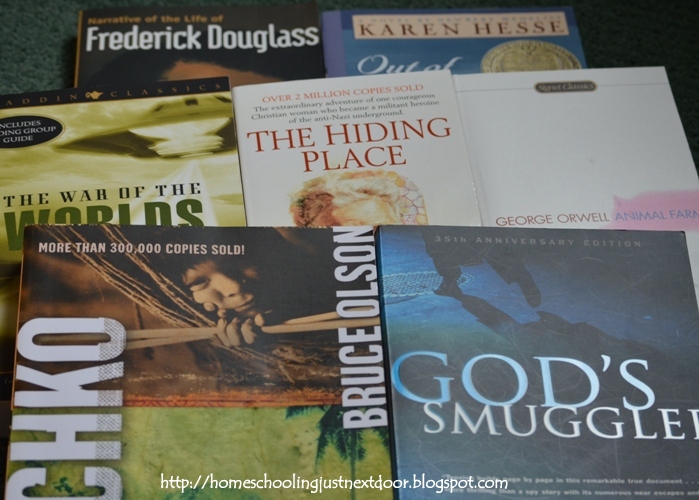
Planning Our Reading and Read Alouds

Books, books, books!  By the end of the school year, I am amazed by how many books we have read together or independently.  Each one is a treasure.  Planning our reading and read alouds for the upcoming school year, I look forward to opening each one and finding the wealth of enjoyment and information hidden within its pages. 

After many years of homeschooling, I know that no matter what list I begin the year using, it will change with additions and subtractions as the year progresses, but I still like to start each year with a solid direction. 

The planned read alouds for our upcoming school year (2012-13)...


The planned reading for my eighth grader...


The planned reading for my sixth grader...


The planned reading for my fourth grader...


By the pictures, you can probably tell some of what we'll be studying.  Our history lessons will cover from about 1830 to present day, which means a lot of our readers and read alouds will coincide with our history lessons.  However, I am sure as we journey through our school year, we will find many new to us books to squeeze into our days.

Planning a Year


Sometimes it is daunting to plan an entire year for one student, let alone two, or more!

Now that our school year has ended, our year end reports are turned in, and our portfolios are completed, I can turn my full attention to planning for next year.

Typically, I start with the basics.  Using a One Year Summary page, I sketch out when certain sports seasons occur, which months we have breaks, when co-ops begin, and when specific exhibits or special days happen.  For instance, football season runs from August through October.  On those months, I make a note of this.  When we found out The Dead Sea Scrolls would be on exhibit in Philadelphia until October, I made a note of this as well.  We don't want to miss that opportunity!  Our science co-op begins in August, but our Friday co-op doesn't start until September.  Both of these are included on the summary. 

Then, I create a One Year of Studies plan for each child.  Each is simply a grid of subjects.  I list how I will approach and teach each subject.  Will the class be taught by me?  If so, with what books or texts?  Will the class be covered by a co-op?  Or will we seek a tutor's help?  These are the kind of basic questions I try to answer on this planning page.  Once everything is filled in, it allows me to check for balance as well.  Are there too many items in the science category and nothing in the history block?  Did I forget to plan for art or music?   This also ensures that I have planned to keep the core classes as our main focus without neglecting our extras.

If you are beginning, or already knee deep in the planning phase, for next school year, then perhaps these forms will help you as well.  They are available here.

Later this week, I hope to share more of our upcoming school year, including the books we will be reading aloud next year.


Growing Your Homeschool - Planning Week

This week is party week planning week at Growing Your Homeschool!  For the next few days, we are sharing some themed activities and ideas for studying governments and spring and celebrating St. Patrick's Day and Easter.  Today, I have compiled a few activities and ideas for studying presidents, elections, and U.S. government.  I'd love for you to stop by any time this week to share a few of your own ideas for incorporating any and all of these topics into our homeschools.

Growing Your Homeschool

Planning for Another Year

This school year is only half over and I have already started thinking about the next. 


It's not that I want to rush through the second half.

No, I want to take the time to seriously consider what is working, what is not working, and any changes my husband and I want to implement next year. 


This is a large project that takes some time, but it is well worth it.

How about you, are you starting to plan for next school year, or do you wait until later? 

Beginning Again After a Holiday Break

Eight o'clock rang on the chimes, but I was still finishing up the day. To describe the day as hectic would have been an understatement. However, the day was not without some positive aspects. We did finish a day of school. It was sporadic and patched together, but a day of learning took place and progress was made. There was very few complaints, and even some laughter.

It was our first day back to our school routine after a ten day holiday break, and I declared this would not happen again. 


How do you begin again? After taking some much needed time off for travel, family visits, holiday celebrations, rest, and relaxation, just how do you get back into the homeschool routine you had already established before your break?

To read the rest of this article, visit Growing Your Homeschool.

Altering Lesson Plans

During the second time I made apple bread this autumn season, I altered the recipe.  I was confident in the recipe and my ability to follow it successfully.  I was also equipped with the knowledge that I could alter the recipe by decreasing the amount of sugar.  With the sweetness of the apples and the other ingredients, I knew a little sugar would never be missed.  So, I altered the amount and made the bread.  NO ONE noticed.  It still tasted great.


Lesson plans are a lot like recipes.  They tell you what you need (ingredients) and how to put them all together (method).  But just like the apple bread recipe, you can alter lesson plans to suit your family. 

To read the rest of this article about altering lesson plans visit Growing Your Homeschool.

Easy Planning for Large Play Groups

When I first started organizing play groups, I would stress over the details.  It became more of a burden as I tried to host the 'perfect' play time in our home with specific activities.  Now that I've let go of that 'perfect' image, and have embraced a more realistic play group, planning has become a cinch.

This is how we get large groups together...
  1. Find a park that is free, shaded in the playground area, relatively easy to find for newcomers, and has restrooms.
  2. Set a date and time that is convenient.  Our group prefers the end of the week, either a Thursday or Friday, from 11 AM to 2 PM.  Plan for each family to bring their own lunches.
  3. Invite all your friends with children and open the play date to their friends as well.  Our typical invite is via email with a friendly comment of 'feel free to invite others to join the fun' message attached at the bottom.
The time spent with friends is refreshing for the children and me.  The amount of families attending each time fluctuates, but always there is a connection and camaraderie of the moms and children.  So much so that I am often asked by moms who have children in school, if they can still come to the play group during the school year.  And, of course, they are welcomed! 
Related Posts Plugin for WordPress, Blogger...