Showing posts with label Art Appreciation. Show all posts

Artist Study - Claude Monet


Recently, we took a few days to learn more about Claude Monet.  To create interest, we began with a hands on project from The Usborne Art Treasury, by Rosie Dickins.  The children listened as I read the short biographical piece and looked intently at the picture Water Lilies - Morning.  They liked learning the tidbit about Monet painting while sitting in a boat.  Then, they followed the outlined steps to create "Layered Lilies" out of tissue paper.  The pictures below show their effort and results.


Then, I gave each child a biography and word search from Making Art Fun.  The children took a day or so to read and complete the word puzzle.

Afterwards, each of the older children read a library book and presented an oral report about Claude Monet.  Our youngest listened as I read aloud two picture books about Monet.

Years ago, I had been to an exhibit of Monet's later works.  Since I still have the book from it, the children were able to view multiple paintingsAnother book from our own shelves offered a chronological viewing of many of his works.

Finally, to end our unit on Monet, we watched Linnea in Monet's Garden via Netflix.

Resources:
The Magical Garden of Claude Monet, by Laurence Anholt
A Blue Butterfly: A Story About Claude Monet, by Bijou Le Tord
Claude Monet, by Catherine Nichols
What Makes a Monet a Monet? by Richard Muhlberger
Artists Profiles for Kids: Claude Monet, by Jim Whiting
Who Was Claude Monet? by Ann Waldron


Are you looking for ONE book about Claude Monet that includes biographical information, art appreciation, hands on projects, and art terms?  Then might I suggest:
Famous Artists: Claude Monet, by Anthony Mason

Art Appreciation for Young Students


We were at the library {shocking I know!} and during a search for a book on knitting, I found three new-to-us art appreciation books for younger students.  All three are by the same author, Bob Raczka, and personally, I recommend all three!


Three great art appreciation books:

Art Is... by Bob Raczka begins each thought with the title and tells readers what art is.  Each attribute is accompanied by a well known piece of art.  The author does not limit his selections to famous paintings and sculptures.  He includes fabric tapestries, buildings and even lamps.  For instance, when he says it is "enlightening," the picture displays a beautiful table lamp by Tiffany.

No One Saw: Ordinary Things Through the Eyes of an Artist, by Bob Raczka capitalizes on the idea that we each individually see and experience the world uniquely.  Thus, our art work, and the art work of famous artists reflects what we see and experience.  The text is arranged to have a rhythmic flow with quite a few rhymes of artists' last names as well.  This book predominately pictures paintings.

Unlikely Pairs: Fun with Famous Works of Art, by Bob Raczka is one unique book!  My youngest son and I enjoyed the quirky and quite unlikely pairing of famous paintings.  Most combinations presented a humorous take on the connection between the two art works.  Whether it be a continuation of the pictures or a similar subject, the end result was a different, but creative way to connect art work from different time periods and styles. 

Artist Study - Georges Seurat

Georges Seurat, a French artist, is probably most famously known for painting with pointillism {dots of paint}.  Though he only lived for 31 years, from 1859-1891, Seurat painted memorable pictures which influenced many artists.

We began our lesson with a reading of The Life and Work of Georges Seurat, by Paul Flux.  Presenting a brief overview of his life, this picture biography hits the highlights and offers interesting tid bits about his life and art work. 


After the reading, the children tried pointillism.  I had printed this coloring page from Making Art Fun, and the children used markers to color the page.  As an added bonus, I used this opportunity to review primary and secondary colors.  Each child had three markers: blue, red, and yellow.  They used these primary colors to create the secondary colors of orange, purple, and green.  Pointillism is a technique which uses dots of color to create 'true' colors in a painting.  By using dots of red and yellow side by side in an area, the children were able to create an area of orange.


Then we viewed A Sunday Afternoon on the Island of La Grande Jatte (painted 1884-86) because we have a rather large print of this hanging in our utility room. {Doesn't everyone decorate their utility rooms with beautiful art prints? Maybe that's just us. Personally, I wanted something pretty to look at when doing the laundry.}  The children are pretty familiar with the painting since they help fold the wash.  Even so, we completed a picture study of it. 


We finished our lesson on Seurat with our own attempts at pointillism with paint. First the children outlined a subject. Then, picked paint colors. They used cotton swabs {many} to fill in their paintings with dots of paint.  Afterward, the children declared pointillism to be 'difficult,' but expressed a new admiration for Seurat's use of it and the results he achieved.  {Folding laundry may have just gotten a bit more enjoyable for them as well.} 


For review, a few days later, I gave each of the older children a printed copy of Making Art Fun's artist biography and their word search.  It was a great way to reinforce what they had learned earlier in the week about Georges Seurat.

Artist Study - Georgia O'Keeffe

For our very first week of school, I wanted to do a simple lesson on noticing details.  What better artist to choose than Georgia O'Keeffe, who took often overlooked small details and magnified them for all to see the beautiful, graceful lines and colors.  Additionally, she lived from 1887 to 1986, which fits perfectly into the time period we are currently studying in our history lessons.

I began the lesson with picture study.  We viewed four paintings by Georgia O'Keeffe.
These included:
Red Hills and Bones, 1941
Autumn Leaves No. 2, 1927
White Rose with Larkspur, No. 2, 1927
Jimson Weed, 1932

For Red Hills and Bones, the children described the subject, colors used, identified foreground, background, and effect.  We then discussed if we'd like to travel through this painting and the emotions it stirred.  Of course, we then noted all the details O'Keeffe included on what appears, at first, to be a simple landscape.

Autumn Leaves, No. 2 followed.  My youngest traced the lines of the leaf.  The older children noted the use of analagous colors, shadows, highlights, and repetition.  We compared the use of similar color pallette to the first painting, but the difference in emotional responses. 

For contrast, we viewed White Rose with Larkspur, No. 2.  The children noted the usage of cool colors and discussed the effect in comparison to the warm tones used in the previous two paintings.  They tried to imagine what the roses would smell like. {Since we have rose bushes this was easily done.}  Then the children examined the painting for minute details.

Finally, we turned to The Usborne Art Treasury, by Rosie Dickins.  We viewed the copy of Jimson Weed, read the biographical information contained within the book, and tried our own "Petal Collage." (pp. 78-79)  My children's pictures...


I love how each child completed the same project but with their own personality and preferences shining through.


The Week Before School 'Officially' Starts

...a weekly wrap up


We have had a great last week of summer break!  Though I wouldn't be honest, if I didn't add that I am sad to see our summer break end.  We will spend next week slowly easing back into our school schedule.  Which means, we'll probably do half days of academics and half days of 'phys ed' - ya know, the kind that requires a pool. {wink, wink}


1.  Our free* field trip to Brandywine River Museum to see Summer Sojourns: Art on Holiday.  Though it was a wonderful exhibit, the boys like the illustrative works of Howard Pyle and N.C. Wyeth better.  Our oldest son has a copy of Treasure Island which features Wyeth's illustrations, and the boys had fun pointing out all the pictures.  The girls liked Andrew Wyeth's Night Sleeper and Master Bedroom, both of which feature his dog napping.  We decided on a 4" by 6" picture postcard of Portrait of Pig, by James Wyeth (original is 48" by 84" - it is huge!) to send to a five year old child we sponsor through Compassion.  It was my daughter's favorite picture when she was five.

{*On Sundays, before noon, there is free admittance.}

2.  Tuesdays, in August, are dollar days at the Natural History Museum.  I hope to share more about our trip sometime next week.

3.  Monday, we were at the library so our youngest, who had finished 30 hours of reading/being read to, could get his bag.  Now, he has one just like his older siblings!

4.  Our two older children finished Andy Stanley's Five Things God Uses to Grow Your Faith video series with my husband facilitating their learning.  My husband and I had been through the materials earlier this summer and wanted to share it with our older children. 

5.  I have fond memories of using sign language as a child.  My second grade teacher taught us the alphabet, and I loved spelling words on my fingers.  {She also taught us Braille, but I completely forgot that.}  Later, when my children first began to speak, I taught them a few simple signs for 'more,' 'please,' and 'thank you.'  We also used signs for 'yes' and 'no.'  As they aged, we have gotten away from using any sign language.  Truthfully, I miss it.  So when I saw a few resources at the library for teaching sign language, I borrowed them.  This past week, all four children watched Signing Time! Practice Time, Level 1 ABCs and 123s as a brief, but thorough introduction to sign language.  We are now spelling things and counting with our fingers.  It also brought back memories of the simple words we signed when they were toddlers.  My eleven year old daughter was signing 'more' and 'please.'  Which led my oldest son to sign 'thank you.'  Neither had signed those words for more than eight years! 

6.  With the Olympics being aired everyday this week, we were, of course, watching!  We picked up Field Events in Action, by Bobbie Kalman and Queen of the Track: Alice Coachman, Olympic High-Jump Champion, by Heather Lang at the library to go along with this past week's Olympic obsession track and field. {My small confession: I love the Olympics! In fact, we were almost late to church because I was watching the marathon...ahem.}

7.  And, because we keep returning to Shakespeare, we listened to Greathall Productions, Inc. Shakespeare for Children, as told by Jim Weiss.  This CD contained "A Midsummer Night's Dream" and "The Taming of the Shrew."  Oh, how the children and I laughed!  {"The Taming of the Shrew" has become my new Shakespeare favorite.}

8.  We spent most of the afternoons beside in the pool. 
Hot temperatures + Hazy skies + Humid air = Pool {for our family!}
The children also tried speaking under water with sign language (#5).  What fun to play and learn!

Before I return to cleaning the house and preparing the school room for our official start next week, I want to share two quotes from signs we passed on the way to the art museum...

One was in front of a church.  On it, we read:

 "Experts built the Titanic, Amateur's built the Ark"

The other sign was in front of a local high school.  It declared:

"Read a BOOK, not fb or twitter."


Both made me laugh, and hopefully you share the humor.
Happy Friday!


Find more weekly wrap-ups at:
Homegrown Learners

Art Books from Our Library


Not only did I recently find a slew of math resources at our library, but I also found a few art books.

Seen Art? by Jon Scieszka and Lane Smith
In this comical book, the narrator is seeking his friend Art.  Every time he asks someone they point him to MOMA (New York's Museum of Modern Art).  He easily finds the building, but still can't find Art.  He views paintings, like Van Gogh's Starry Night and walks halls with pop art.  All the while, he asks other museum goers where Art is.  Each one takes him to a painting or work of art and shows him what they consider Art.  The narrator ends up touring the entire museum, but doesn't find Art.  It is a comical story with a cute ending.  We enjoyed how actual pieces of art were incorporated into the story.  It was a seamless way to intertwine art appreciation and a fun story. 

1, 2, 3, I Can Make Prints! by Irene Luxbacher
Using fingers, sponges, craft foam and modeling clay, little hands are encouraged to make art prints.  Many adorable project ideas are included in the pages.  Some of our favorites are a caterpillar made from a circular sponge stamp, sleeping ladybugs on top of a leaf made from placing a drop of green water color paint onto a piece of paper and folding the paper to spread the paint around, and a crazy ant maze made from a foam tray block print.

Mixing facts, history, appreciation, and art projects, this book offers a little of everything in one volume.  Just about every architectural element is covered, including stained glass, candle wax, tipis, houses, bridges, walls, roof tops, and floors.  Children interested in building or making sculptures will find a lot of great ideas, which they can easily complete, throughout the book.

Art as Science, by Christine Fleming
After an introduction to art, the history of art, and everyday art, the book delves into its main topic: the science of art.  Art and science intersect in many different ways, and this book means to introduce children to a few of those.  Science is used for conservation of art artifacts, matching pigments of paints, determining authenticity of art works, and even creating some artistic illusions and patterns.  Children interested in science may find an interest in art after reading through this book.


If you are able to find any of these titles at your local library, I would highly recommend borrowing them.


{Links are not affiliate links, but are provided for reader's convenience.}

Side Walk Chalk Art


Ever since they could hold a chalk, in the warmer weather, our children have enjoyed drawing on the sidewalks and driveway.  At our old home, we had an expansive concrete patio.  One time, the children and I spent days creating a large scale mural of an underwater scene.  Now that they are older and able to draw faster, they create their drawings and murals in an afternoon on our concrete driveway.  It has been a fun, large scale art experience for our children.


In a similar manner, Gregory, the main character of The Chalk Box Kid, by Clyde Robert Bulla, creates a garden from a box of chalk he found.  Only his mural covers three walls of the burnt out factory behind his new house.  Over lunch, two days this past week, we read this endearing story about Gregory who moves to a new part of town after his father loses his job.  


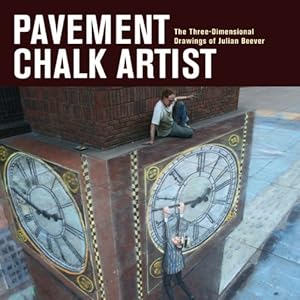
Because of their interest in sidewalk drawing, and this recent read aloud, I thought they would like Pavement Chalk Artist: The Three-Dimensional Drawings of Julian Beever, by Julian Beever.  I was right!  Beever is a phenomenal artist who creates realistic, 3D drawings on city sidewalks.  The book is partly autobiographical and partly a catalog of his work.  We did not read the book from cover to cover.  Instead, we simply browsed through the book, discussing his techniques, and appreciating his art.  The children and I were fascinated with how lifelike the pictures seemed.  In the text, Beever discusses how he got started in pavement drawing and some of the challenges like drawing over the cracks, obtaining permits, and weather.

Pavement Chalk Artist: The Three-Dimensional Drawings of Julian Beever

Stained Glass-Like Art Project

Last week, I shared my preschooler's dinosaur craft, and I commented that I wanted to possibly alter it for a co-op class.  Well, Friday at co-op, I was able to use a similar idea for the children's art project. 

The class is American History (art and writing) for third through fifth graders.  Using a free curriculum from National Endowment for the Humanities, called Picturing America, my co-teacher and I select one art work to study over two classes.  During the first class, we discuss the historical aspects of the time period or art work and assign creative writing projects.  The second class is spent reviewing the creative writing pieces and creating an art project. 

For the past two classes, we have been studying Louis Comfort Tiffany's Autumn Landscape - The River of Life (1923-1924).  Our first class, we discussed the artist's life and works, stain glass techniques, art elements within the piece, and took a walking tour of the church building, viewing the stained glass within it.  Since the subject matter of the selected piece was nature, my co-teacher taught the students the principles of writing a haiku.  Each child then was assigned to write a haiku for our next co-op day. 

The second class for Tiffany's Autumn Landscape - The River of Life was last Friday.  We began with a review of stained glass and art elements.  Next I outlined the project.  We used pages from Wildflowers: Stained Glass Coloring Book and Woodland Animals: Stained Glass Coloring Book, colored tissue paper, glue, scissors, and self sticking laminate sheets to create these:

The one of the left is my third grade {bright color loving} daughter's,
and the one on the right is my fifth grade {likes realistic end results} daughter's.


Method:
1.  Using a sponge brush, spread white glue thinly over a section of the picture
2.  Place pre-cut tissue paper squares (altering shape if desired) over the glue, press slightly
3.  Continue the process until entire page is covered
4.  Allow to dry, completely
5.  Using self sticking lamination sheets, adhere one sheet to the tissue papered side
6.  Trim excess off the lamination sheet
7.  Turn over to reveal a lovely stain glass like art work


For anyone interested: Picturing America has an educator's page full of resources and lesson plans free for downloading.

An Ultimate Art Memory Game

Art Memo II GameArt Memo GameSince I love art, it is my hope to foster an appreciation of art in my children.  Which means we have a few art resources around our home including an Art Memo game.  Played just like the Memory games by Hasbro, Art Memo uses famous paintings as matching pieces.  It comes with a large reference page that includes a black and white picture of the painting, its title and artist.  Our children have learned the names and artists of many famous paintings just by playing the game.  There are a few paintings included in the game that we removed due to our own personal convictions.  However, even with a few less paintings the game is still challenging and fun to play.  The manufacturers have made three editions, including Art Memo, Art Memo II, and Impressionists Memo Game.

Last Friday evening, we decided to up the game a bit.  Instead of playing with one set of the Art Memo games, we mixed up all three. 

Spread over the entire dining room table, the game was epic.  We divided into pairs, creating three teams.  The two youngest children were paired with my husband and I.  The oldest two comprised the final team. 

At first it seemed impossible, but once we started making matches, it turned out to be a great time.  Since each game comes with a picture guide, we were easily able to return the cards to the appropriate box.


Related Posts Plugin for WordPress, Blogger...