Showing posts with label Insects. Show all posts

A Definite Dollar Day Deal

We've been there before, years ago for this very same deal. Just one dollar got us into a local natural history museum. It was a deal indeed!


This time around, we started with the egg collection. It is a favorite of mine as it reminds me of all the incubators and birds my Great-Grandfather had at his house. He raised a variety of birds. It was an educational trip every time we visited him. He would always take us to see what was 'new'.

While observing the eggs a museum worker brought this little guy around for visitors to see.


Next, we went into a Nature Nook room. Though there were many hands on activities in the room, one of our favorite items was this...


a pinned display of giant grasshoppers.

From the Nature Nook, we entered the special exhibit: Bugs. There were drawers full of pinned bugs, a place to make a large felt insect,


and even a stag beetle demo.


However, the main portion of the special exhibit was a display of larger than life bugs.
 

Each bug was hand crafted by an artist.


The details were amazing.


A side display box showed all the tools the artist used to create the larger than life bugs.


After the special exhibit, we toured the rest of the museum and ended our time within the museum at this interactive mural featuring more insects.


Once again, dollar days were a fabulous deal!


Learning About Decomposers


Last month, we visited a local native garden. The grounds showcased native plants and trees. Amidst the beautiful surroundings, volunteers had set up educational activities for children. One was centered on the role of decomposers in nature.


Children were invited to dig through a log with a garden shovel.


They were to hunt for bugs.


Each time a bug was found, the grown-up volunteer would supply the child with a small container. The containers were topped with magnifying lids allowing children a chance to observe the bugs very closely.


The bug containers can be found here.

Pollination by Bees {Hands On Learning Activity Idea}

For National Public Gardens Day, we packed up and traveled to a local garden. It was free in honor of the day, but truth be told, I would have paid for it. It was worth an admittance fee.

The gardens we visited were cultivated with local flora. Many species of flowers were in bloom and created beautiful vistas for our walk.

Along our walk, volunteers had set up numerous learning stations. Among them was a lesson about pollinators and the process of pollination. One of the hands on activities children were encouraged to do was pollinate flowers with a bee.


Children received a small bee fashioned from yellow and black chenille pipe cleaners.


The bee fit on a child's pointer finger.

Each child was then asked to 'fly' the bee to different large (fake) flowers set up in the grassy lawn.

As the children flew their bees onto each flower, the bee would become coated with 'pollen' (a corn meal-like mixture).


Taking the pollen from one flower to the next provided each child with a hands on pollinating experience. Not to mention it was fun!

My only disappointment was not having this idea before I taught about bees during co-op science. However, as I'll be teaching botany to first and second graders next year, this is one hands on learning activity I want to include.


Related:
Experiments on Insects
Ladybug Observations
Ladybug Craft - Demonstrating Both Sets of Wings


Demonstrating Ladybug Wings


The entire class was devoted to beetles and true bugs. All 19 Kindergarten through 2nd grade listened intently as I described the unique characteristics of each grouping. They were fascinated by the two sets of wings. I was hoping they would be.

Yet, I knew it might be hard to understand, especially when you are five, or seven, years old. The week before the lesson, as I prepared to teach it, I tossed around several ideas on how to best illustrate the concept. I also wanted something the children could make and take home with them.

For starters, I collected five real live ladybugs from my parents house. We kept them in a premade habitat for a few days. The students watched them with fascination. A few of them even displayed their flying wings as they moved about the tiny half globe container. It was perfect!

Then I set about to find a hands on project which students could take home with them. I searched the internet. Ladybug projects are prevalent, but not one of them showed the flying wings like I wanted.


Finding this pattern, I was inspired to add a set of tissue paper wings for flying wings. The addition of this pair of wings allowed children to not only see the two sets of wings, but to move them apart themselves.


The combination was just what my co-op class needed to illustrate the concept.


Ladybug Observations


It's the last week for our insect study. We have collected bugs, watched complete metamorphosis with butterflies, and studied insects for seven weeks. Despite all that, we couldn't resist pulling out the Lady Bug Land, which was stored in our attic this past week. We were visiting my parents and collected five live ladybugs.


After we placed them into the artificial habitat, we scavenged through our pantry for something to feed them. Lacking raisins, we settled on craisins. These ladybugs liked them!


After observing them for several days, we took them outside.


Then, released them.


From Caterpillar to Butterfly

 
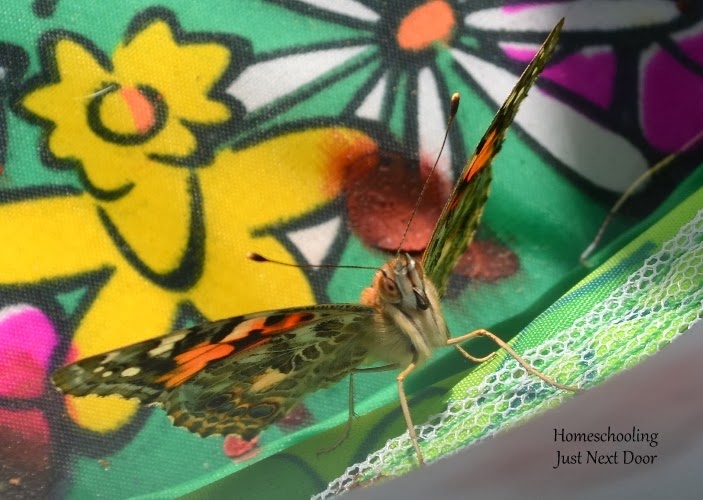
Weeks ago, they were creepy crawling caterpillars. Since then we have watched the complete metamorphosis occur.
 
Even though we have seen it before, I must confess, each time, it is amazing to observe!


Birds and Bees


On our recent nature walk, we 'stumbled across' numerous honey bees busy at work. We watched as the honey bees dove down into flowers collecting nectar and pollen. Since my youngest son is learning about insects in his science co-op class, it was perfect timing.


Throughout the gardens there were educational enrichment activities for both bees and birds.


These, of course, were fun activities to review the bird unit from the beginning of the school year.


Creepy Crawly Caterpillars


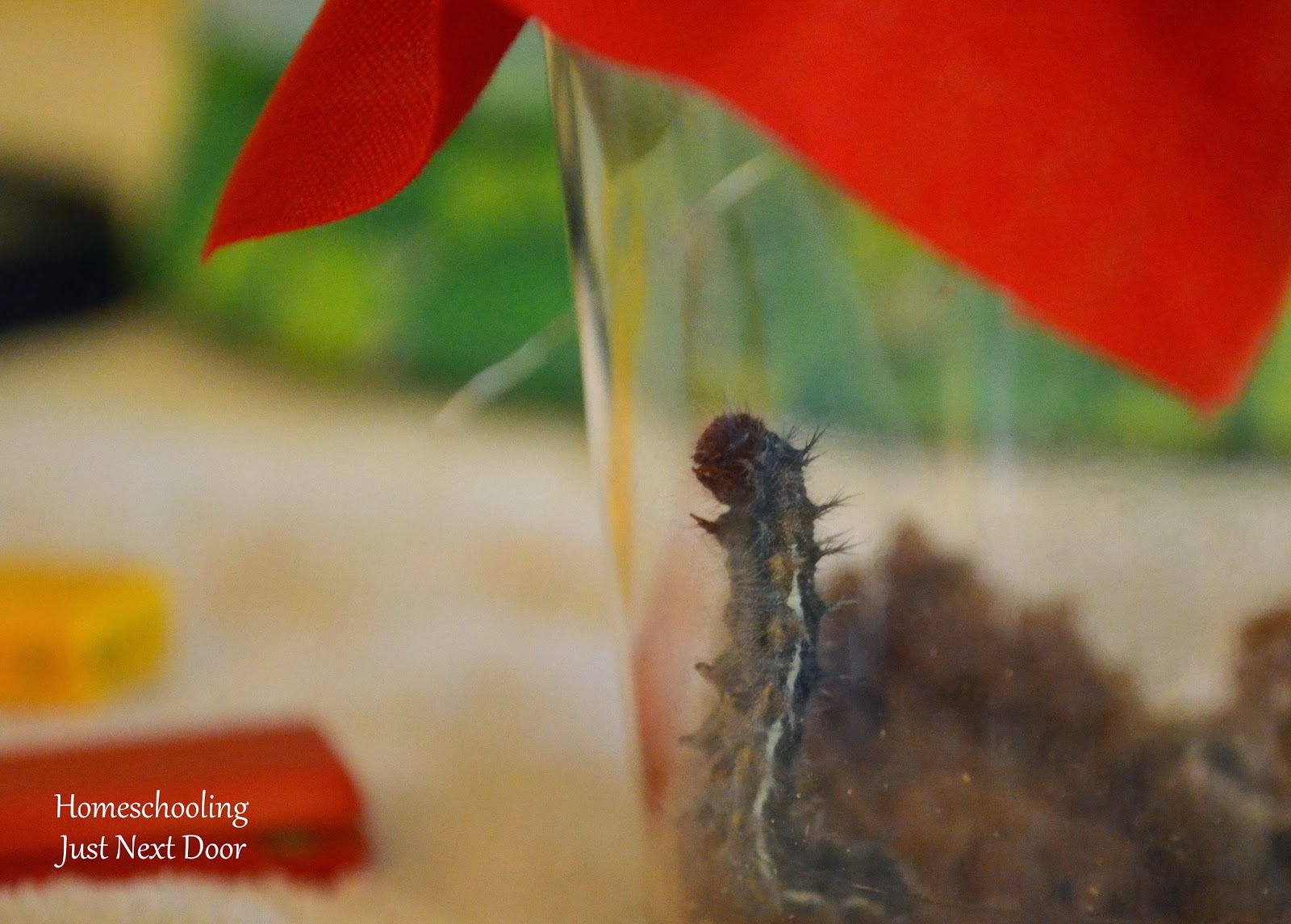
Admittedly not as cute and cuddly as the chicks, but still intriguing to watch the metamorphosis. The last creepy crawly caterpillar has entered the chrysalis stage.


A True Confession


Ever since this science experiments on bugs, I have been trapping and freezing bugs. to examine.
It started as a quasi-academic procedure but now it seems like it might be a possible sick obsession.
What might be even worse is the fact that I've caught a lot of these bugs (ten to be exact) in our home.

However, I came to the conclusion I had a problem during our vacation. Yep, I was collecting bugs while on vacation.


Several friends could be pointed out as enablers bringing me bugs and various containers to use. {Ahem, you know who you are, but don't worry, you will remain anonymous. I won't tell.}

For the record: We'll use them all in our K-2nd science when we study creepy crawling animals.
We'll use magnifying glasses and count body parts and legs.
We'll examine wings and coverings.
In short, these bugs will be put to good use!

And, who knows, by that time, each of the twenty children may have their own bug to look at...


Summertime Science - Experiments on Insects


It started with a buzzing fly.
That fly was annoying.
Zooming here and there.
Flying by our heads like a jet by a control tower.
Then I remembered.
While planning for next year's science class, I had read how to torture experiment on an insect.

We captured the fly.
Use a small Ziploc baggie. Wait for fly to land and 'rest' on a wall or screen. Encase the fly in the baggie by opening it and pressing the opening against the wall or screen. Patiently wait for fly to move off screen and quickly close opening.

Next, we placed the fly in a tub of water to 'drown' it.
It doesn't really drown after a few minutes. It simply goes into a shut down mode; hence why this experiment works.

One of our daughters gingerly lifted the fly from the bowl and placed it on a paper towel.


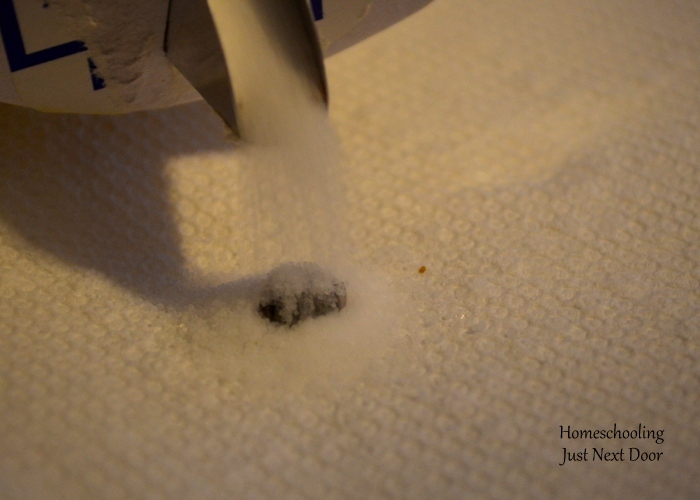
Then, one of our boys poured regular table salt over the fly.


And, I uncovered it a bit.
So it wasn't crushed by the excess salt.
Then we waited.


Revived fly lived another day.
Well, eventually.
After this experiment, we refrigerated it to see how the cold temperatures would effect it.
Then, we let it go.


It had earned its freedom!


*The science behind this experiment and the exact procedure are found in Apologia's Exploring Creation with Zoology 1.


Related Posts Plugin for WordPress, Blogger...